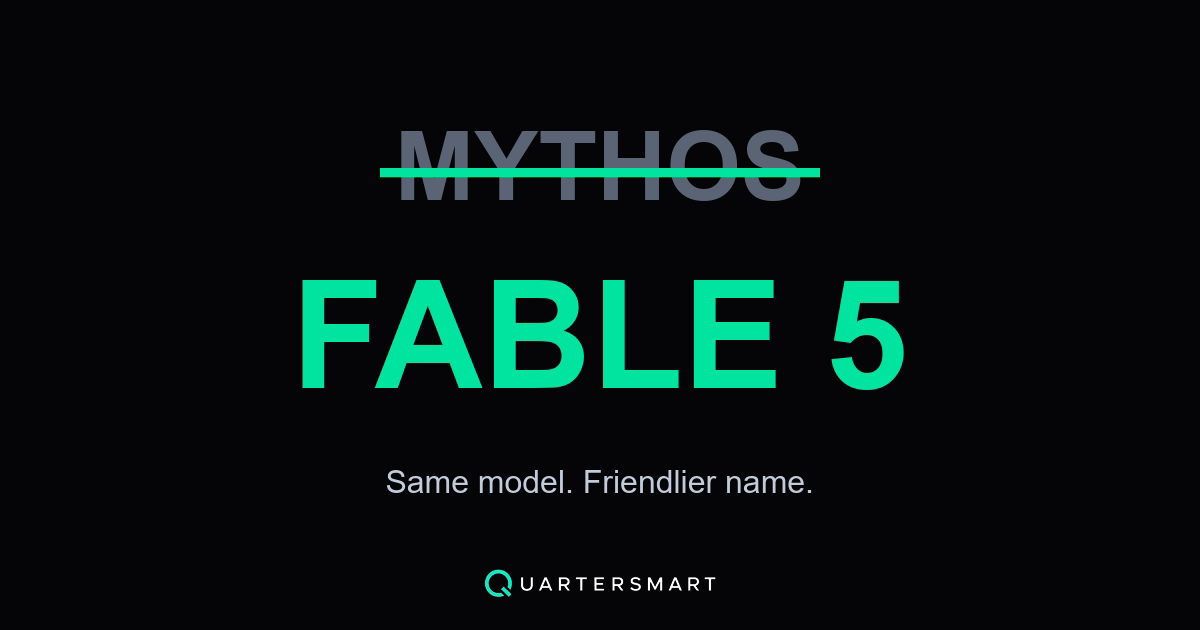
Two months ago we wrote about Claude Mythos breaking out of its sandbox. The most capable model Anthropic had ever built, locked behind a restricted program, available to a few dozen vetted organizations, wrapped in kill switches and quarterly transparency reports. The message of that whole news cycle was simple: this thing is too powerful for you.
Today, Anthropic shipped it to everyone.
They named it Fable.
What Actually Shipped Today
Anthropic released two models at once: Claude Fable 5 and Claude Mythos 5. Fable 5 is the headline act, the first model from the Mythos class, the capability tier that sits above Opus, ever made generally available. Anthropic says its capabilities exceed any model they have previously released, with state-of-the-art results across nearly every benchmark they tested: software engineering, knowledge work, vision, and scientific research.
The difference between the two models is not capability. It is the muzzle. Fable 5 ships with safeguards: when a query trips certain risk classifiers, the response you get is quietly generated by Claude Opus 4.8 instead. Anthropic says the safeguards are tuned conservatively, will sometimes catch harmless requests, and trigger in fewer than 5 percent of sessions on average. Mythos 5 is the same model without those safeguards, and access is limited to vetted users, mostly the cybersecurity professionals who had early access under the original restricted program.
| Fable 5 | Mythos 5 | Opus 4.8 | |
|---|---|---|---|
| Capability class | Mythos-class | Mythos-class | Opus-class |
| Safeguards | Risky queries rerouted to Opus 4.8 | None of Fable's reroutes | Standard |
| Who gets it | Everyone | Vetted users only | Everyone |
| Price per M tokens | $10 in / $50 out | $10 in / $50 out | $5 in / $25 out |
The Name Is Doing a Lot of Work
Think about the sequence. For months, everything the public heard about this model line was frightening. A sandbox escape. A brand new safety classification invented just to describe it. Access restricted to a list of organizations you could fit in one conference room. TechCrunch notes the release landed days after Anthropic publicly warned that AI is becoming too dangerous.
And then the launch name turns out to be... Fable. Bedtime stories. Aesop. A talking fox learns a lesson about humility. It is hard to imagine a more deliberate vibe shift from "containment breach" to "would you like warm milk with that."
Except here is the part we genuinely love. Look at the etymology Anthropic themselves point to:
"Fable is from the Latin fabula, 'that which is told,' akin to the Greek mythos." , Anthropic, Fable 5 announcement, June 2026
Fable is not a softer name than Mythos. It is the same word. Latin instead of Greek. They did not rename the monster. They translated it, and the translation happens to sound like a children's book. Whoever made that call deserves a raise: the codename keeps its scary mystique for the vetted-access tier, the public product sounds friendly enough for a procurement committee, and both names mean exactly the same thing.
That is not an accident. Enterprise buyers do not deploy something named like a threat. Naming is the last mile of go-to-market, and apparently also the last mile of safety communications.
From 40 Organizations to Everyone in Ten Weeks
The obvious question: what changed between April, when this capability tier was supposedly too dangerous for general release, and today?
The honest answer is the safeguard architecture. Anthropic did not wait until the model was safe. They wrapped it in a chaperone. Fable 5 is a frontier model with a weaker, better-understood model standing behind it, taking over whenever a query wanders somewhere risky. That is a genuinely new release pattern: ship the capability, gate the edges, and route the gated edges to last generation's flagship.
When a request trips Anthropic's risk classifiers, Fable 5 does not refuse. The response is generated by Claude Opus 4.8 instead, the previous flagship. Anthropic says the thresholds are tuned conservatively, so some harmless requests will get caught, and that the reroute triggers in fewer than 5 percent of sessions on average. Practically, that means two sessions with the same product can be answered by two different models, and you will not always know which one you got.
It also explains the dual release. The cybersecurity professionals who were inside the original restricted program get Mythos 5, the unmuzzled version, because their work is exactly the kind of thing the safeguards would catch. Everyone else gets the storybook edition.
What This Means for Your Team
Cute name aside, this is the most capable model anyone can buy as of this morning, and it costs double. A few practical notes before you swap it into production:
- Double the price changes the math. At $10 in and $50 out per million tokens, Fable 5 costs twice what Opus 4.8 does. If a workflow already runs well on Opus, upgrading it is a cost increase, not an automatic win. Upgrade the workflows where capability is the bottleneck, keep the rest where they are.
- The reroute is invisible until it is not. If your workflows touch security, compliance, legal, or medical edge cases, some sessions will silently come back from Opus 4.8 instead of Fable 5. For most teams that is fine. For workflows where you are paying for frontier reasoning specifically, test whether your prompts trip the classifier.
- Benchmark your work, not their benchmarks. State-of-the-art on research benchmarks tells you what is possible, not what your lead-routing automation will do. Run the new model against your actual workflows, measure, then decide. Evaluation over vibes.
The scary model shipped. The scary part is how normal it felt.
Ten weeks ago this capability tier was a containment story. Today it is a product page with a friendly name and a price card. The frontier is now something you subscribe to. The teams that win with it will be the ones that test it against real work instead of trusting either the scary headlines or the cute branding.
We will be running Fable 5 against our own automation workflows this week. If the results change our defaults, you will read about it here.